


MCP Server: The key enabler of productive AI in customer data management


Uniserv’s strength lies in data quality and Customer Data Management. MCP (Model Context Protocol) takes this strength to the next level. Instead of isolated services, interconnected intelligent systems emerge. AI does not replace existing applications, it becomes the orchestrator. The MCP Server ensures that the right tools are used in a controlled, transparent, and secure way.
Artificial intelligence has arrived, including in the world of customer data. Yet its impact often remains limited. The reason is simple: a Large Language Model (LLM) knows a lot, but rarely the data that truly matters to a business. This is exactly where MCP servers come in. They make AI actionable and bring its value to where it matters most: operational processes.
Technically, this is based on a clearly structured architecture. The MCP Server provides functions (“Tools”), data (“Resources”), and interaction logic (“Prompts”) in a standardized way. AI can use them in a targeted manner without any knowledge of the underlying systems.
For Uniserv users, the benefit is clear: a flexible and extensible integration layer that cleanly decouples the AI model from the application.
What an MCP Server really is
The Model Context Protocol (MCP) is an open standard that connects AI applications with external systems. You can think of it as a universal interface, similar to USB: a standard that allows a wide range of systems to connect and exchange information.
An MCP Server acts as the intermediary. It sits between a language model and the company's actual systems, such as databases, APIs, and applications. It translates requests from the model, retrieves the required data or functions, and returns structured results.
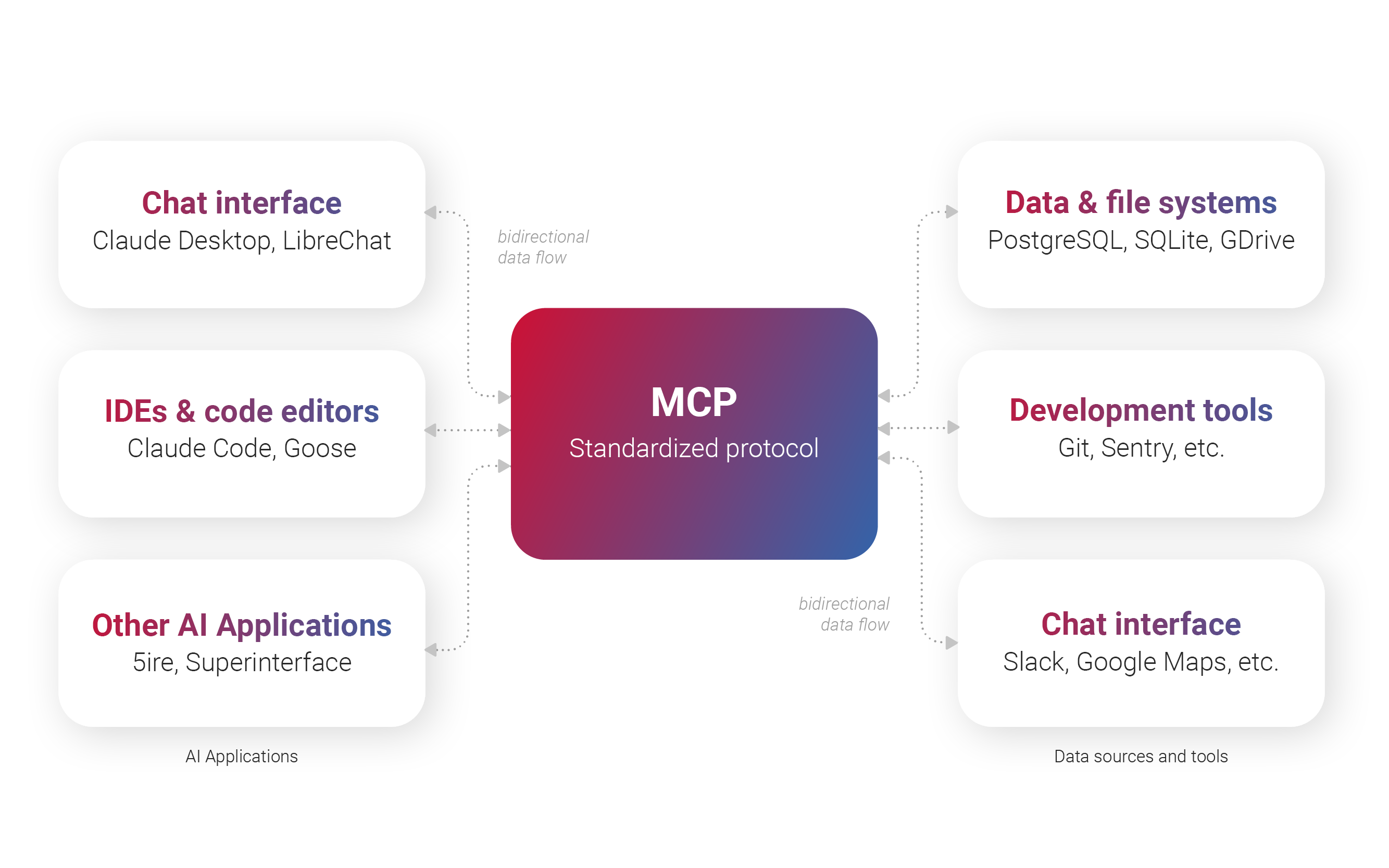
Image source: https://modelcontextprotocol.io/docs/2026-07-28/getting-started/intro
In short, the MCP Server provides the missing context. Without context, every AI remains superficial. The MCP Server enables an AI agent to interact autonomously with Uniserv solutions such as address validation and duplicate check, without human intervention.
What does this mean in practice for Uniserv customers?
Uniserv’s decision to embrace MCP Servers is more than just a technological step. It is a clear signal: data quality becomes AI-enabled and, as a result, operationally actionable.
1. Direct access to trusted data quality
MCP-Server ermöglichen es, dass KI-Anwendungen direkt auf Uniserv-Services zugreifen – etwa zur Adressvalidierung oder Dublettenprüfung. Statt ungenauer Schätzungen liefert die KI konkrete, valide Ergebnisse.
2. Consistent decisions in real time
AI-driven processes can access up-to-date, quality-assured data. This helps prevent inconsistencies and improves decision-making across business functions, including sales, customer service, and marketing.
3. Fast integration without disrupting existing systems
Thanks to its standardized approach, MCP makes it possible to connect existing systems without redesigning them. MCP decouples AI from individual implementations, a major advantage in complex IT environments.
4. Future-proof architecture
MCP is increasingly becoming an industry standard. Organizations that adopt it today are building an architecture that will remain compatible tomorrow. This is exactly the level of future-proofing Uniserv customers can rely on.
Real-world use cases in customer data management
The value of MCP does not become apparent in theory, but in everyday operations.
Use Case 1: Address validation in conversational workflows
A customer service AI assistant receives the question: “Does this address exist?”
Through the MCP Server, the request is forwarded to Uniserv’s address validation service. Instead of providing an estimated answer, the AI returns the validated address immediately and reliably.
Use Case 2: Data enrichment in sales
A sales representative uses AI to qualify leads. Through MCP, the AI can directly access data quality services to enrich or validate records without interrupting the workflow.
Use Case 3: Automated data maintenance
AI-driven processes identify duplicate records or incorrect customer data. Through MCP, they can directly access Uniserv functions to cleanse or consolidate the data.
Use Case 4: Reporting and analytics
Analysts can access structured data through AI-based queries. MCP ensures that these queries are not based on vague assumptions but on verified data assets.
The real value: AI becomes actionable
Without MCP, AI quickly reaches its limits. A language model knows publicly available information. It does not know internal company data and, in many cases, it should not have direct access to it.
At the same time, this is precisely where an organization’s real value resides: in its own data assets, including customer master data, transactional data, address information, and historical records.
Without standardized interfaces, this data remains inaccessible to AI. This is exactly where MCP comes in. It makes enterprise data available in a controlled, secure, and structured way.
The MCP Server transforms a generic AI into an operational business tool. It ensures that responses are not only plausible, but reliable. And it brings AI to where organizations need it most: into real processes, connected to real data, and governed by clearly defined rules.
For Uniserv customers, this means that data quality is no longer just a foundation. It becomes an active component of intelligent applications.
Conclusion: Not hype, but a strategic step
MCP Servers are not technology for technology’s sake. They solve one of the key challenges of modern AI: access to relevant business data.
This is exactly why Uniserv is taking this step. Because data quality only delivers its full value when it is available where decisions are made.
With MCP, data expertise becomes real business capability: intelligent, efficient, and actionable.

We are here for you.
Our Customer Data Experts will quickly and competently answer your questions and find a suitable solution for your concern
You might also be interested in: