


Case Study Mechanical Engineering
Inefficiency doesn't just cost profit margins
How centralized data quality transforms and optimizes the sales process
This case study demonstrates how mechanical engineering companies use data quality measures to create a consolidated database. This enables measurable time savings in the sales process through increased productivity, which has been shown to boost margins.

A heterogeneous data landscape hinders efficiency and innovation
#STORY
An international mechanical engineering group with numerous country-level organizations manages a six-figure volume of customer and business partner data across the group in separate, legacy systems. Different CRM systems, local data repositories, and a lack of quality standards result in fragmented, redundant, and often erroneous data records.
Consequently, the sales process is the primary focus of attention. This business-critical process is slow, error-prone, and resource-intensive. Response times are lengthening; a global overview is virtually impossible.
Furthermore, processing customer inquiries requires significant effort, and there is a lack of a robust, company-wide data foundation based on a unified data model.
The planned introduction of a new CRM system highlights existing data quality issues and increases the pressure to modernize. At the same time, there is a desire to introduce AI-powered applications to further boost productivity and secure margins. However, this is a project that cannot be achieved without valid, consistent data.
The causality—that is, the relationship between cause and effect—clearly highlights the need and pressure to fundamentally modernize the system and data landscape.
Establishing a unified global 360-degree view
The goal is therefore to create a unified, centralized 360-degree view of customers and business partners. This is intended not only to enhance transparency but also to simplify and accelerate processes, particularly the sales process. In addition, the aim is to lay the groundwork for future innovations—especially in the areas of AI-based services and automation—which are expected to unlock additional efficiency and productivity gains.
The clear priorities are:
- Reduction of manual data maintenance
- Development and implementation of a unified global data model
- Harmonization of all datasets according to this data model
- Elimination of redundant local third-party systems
- Automated data cleansing, validation, and duplicate checking
- Acceleration of the sales process
- A reliable data foundation as the basis for AI-based applications

Centralized consolidation & global rollout
#SOLUTION
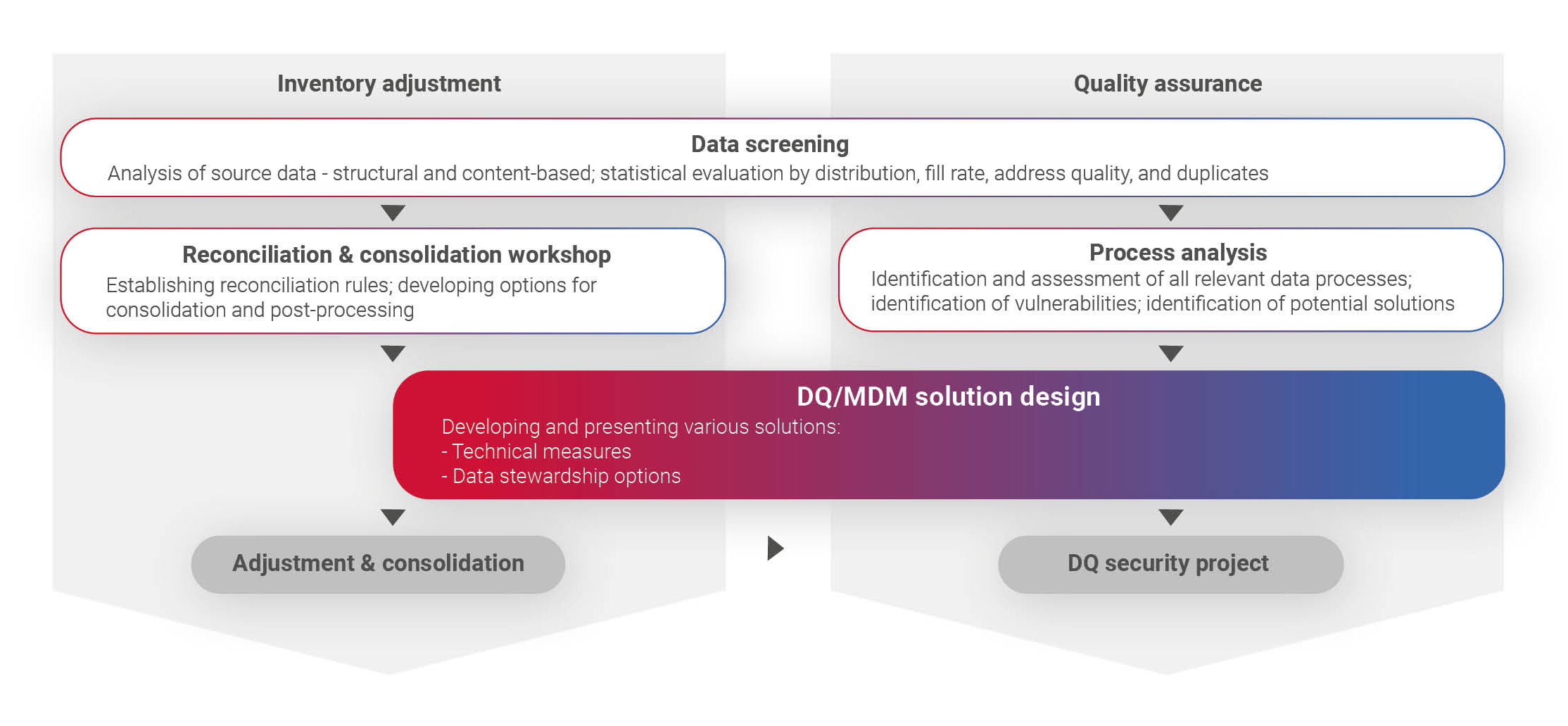
The solution process begins with a proof of concept (PoC). In the context of data quality and data management, this is a limited test to verify whether a selected data quality approach, tool, or data management process works technically and delivers measurable improvements. It quickly provides clarity on the effort, benefits, and scalability of future data management initiatives. Accordingly, it provides hard facts for business and IT decisions.
In this business case, the PoC initially covers a small selection of countries within the global corporate structure. The data available there is consolidated, analyzed, and cleaned in a central platform.
After just a short time, a clear picture of the data situation emerges. Unstructured data records, erroneous fields, missing information, and numerous duplicates dominate. This is a typical finding in structures that have grown in a decentralized manner over a long period of time.
Automated validation and duplicate detection rules can accelerate many data cleansing tasks. The analysis phase confirms the great potential of centralized consolidation — another typical finding in complex structures.
Once the proof of concept has been successfully completed, the solution will be rolled out to all locations. The central environment will be operated as a managed service and will meet high data protection standards. Each country subsidiary will be connected step by step, gradually creating a 360-degree view. With a globally uniform data model, clear rules for data quality, and a central interface for manual post-processing, it is now possible to manage data consistently, efficiently, and transparently.
Advantages:
- Automated golden record creation
- International address validation
- Configurable matching logic
- Precise role and permission model for cross-border collaboration
Increased efficiency, cost savings, and a foundation for AI
#SUCCESS
The results are quickly apparent: the time spent on manual data processing is reduced by about half. Data quality and consistency improve significantly. The business-critical sales process — from initial contact to order placement—is transparent and efficient.
In addition, a central, valid data pool is created, providing — for the first time ever — a solid foundation for AI-powered applications. Such AI-powered applications include recommendation engines, chatbots, automated routine tasks, and analytical methods that make it easier to identify customer sentiments and needs.
With the optimized data foundation, it becomes possible to realign service, sales, and customer communication while simultaneously reducing costs. The harmonization of data enables faster response times, facilitates global collaboration, and sustainably strengthens competitiveness. At the same time, the project lays the groundwork for future innovations—a major step for mechanical engineering companies that view their data as a business-critical asset and are working in highly competitive markets to maintain or even increase their profit margins by expanding their service business.
An overview of the key findings:
- A centralized, consolidated, and validated 360-degree view of customers and business partners
- Uniform data quality standards and a global data model
- Significantly reduced manual post-processing
- High degree of automation in data management
- Cost savings through the replacement of local third-party systems
- Faster and more efficient sales process
- Solid data foundation for customer-centric AI applications and future innovations


Key takeaways
Data as a strategic success factor
- Current situation: Disparate systems with different data structures are hindering sales.
- Objective: A unified, centralized 360-degree view based on golden records with a unique customer ID as the central anchor
- Solution: Centralized consolidation of all customer and business partner data across systems and countries
- Success: Increased productivity through greater efficiency at reduced costs; plus: a reliable data foundation for the use of AI
Consolidated, valid data enables better decisions, faster processes, and sustainably strengthens competitiveness. Accordingly, the project clearly demonstrates that when data quality is consistently treated as a strategic success factor, it leads to tangible efficiency gains, lower costs, and a significant competitive advantage. A reliable data foundation enables faster processes and innovative customer experiences—and thus a significantly higher margin that benefits more than just sales.


You might also be interested in: